
Most beginners don't lose money because they picked the wrong strategy. They lose money because they never find out which parts of their trading actually work — so they keep repeating the parts that don't. You place a trade, it wins or loses, and the lesson (if there was one) evaporates by the next session. A week later you're making the exact same sizing mistake, or chasing the exact same breakout that never holds, with no memory of having done it before.
This isn't a discipline problem so much as a memory problem. Human memory is selective in a way that's actively unhelpful for trading: the huge winner from three weeks ago stays vivid, while the small, boring mistake you made on Tuesday — moving a stop loss ten points, entering two minutes early — fades within days. Multiply that by dozens of trades a month, and it's easy to see why beginners keep repeating the same errors. It's not that the lesson wasn't there. It's that nothing was written down to hold onto it.
Professional traders don't have better memories than beginners. They just don't rely on memory. Every serious trader — from a prop desk junior to a solo swing trader — keeps a record of every trade and reviews it on a schedule. That record is a trading journal, and for a beginner specifically, it's the single fastest way to convert expensive early mistakes into permanent lessons instead of a recurring bill.
This guide isn't a listicle of "10 best apps." It's a straight answer to a narrower, more useful question: what actually makes a trading journal good for a beginner, what features are worth caring about, which ones are marketing noise, and how to choose one you'll still be using in six months.
- A good trading journal for beginners should feel effortless to update — if it takes more than a minute per trade, you'll stop using it.
- Automatic PnL and risk-reward calculation matters more than flashy charts early on.
- The traders who improve fastest review losing trades in more detail than winning ones.
- Paper and spreadsheets are fine to start — but they hit a ceiling fast once you want real analytics.
What Is a Trading Journal?
A trading journal is a structured record of every trade you take — market, entry, exit, size, strategy, and outcome — kept specifically so you can review your own decisions later and get measurably better at making them. It's different from a broker statement, which only tells you what happened financially. A journal captures why a trade happened: your reasoning, your plan, and your state of mind at the time.
The purpose isn't record-keeping for its own sake. It's turning trading from a blur of disconnected events into a dataset you can actually analyze — which strategies have real positive expectancy, which mistakes are costing you the most, and whether your edge is holding up as market conditions change.
Importance is where most beginners underestimate a journal the most. It's tempting to think of it as optional paperwork — something you'll "get to" once trading is already going well. In practice it's closer to the opposite: a journal is most valuable precisely while you're still figuring things out, because that's when you're generating the most mistakes worth learning from and the most data worth analyzing. Traders who wait until they're "consistent enough to bother" usually never start, because without a journal, they never get the evidence that would tell them they're ready. If you want the full breakdown of what a trading journal is and why professional traders treat it as essential, we cover that in detail in our complete guide to trading journals. This article focuses specifically on choosing one as a beginner.
Why Beginners Need a Trading Journal
Every trader benefits from journaling, but beginners benefit disproportionately, for a simple reason: early mistakes are the cheapest ones you'll ever make, and also the easiest ones to keep repeating if nothing is written down.
You learn faster
Without a journal, "learning to trade" mostly means trading more and hoping patterns sink in. With one, every trade becomes a small, reviewable lesson — what you planned, what actually happened, and the one thing you'd do differently. That loop compresses months of trial and error into weeks.
You build real discipline
Knowing you'll have to log a trade — and write down your reason for taking it — makes impulsive entries noticeably less tempting. A journal is quiet accountability that works even when no one else is watching.
Mistakes stop repeating
Beginners tend to make the same handful of errors over and over: moving a stop loss, sizing up after a win, entering before their setup fully confirms. A journal that tags mistakes turns "I think I do this a lot" into "I've done this on 9 of my last 14 losing trades" — a fact you can actually act on.
Risk management becomes concrete
New traders often have a rough sense of "don't risk too much" without a real number behind it. A journal that tracks risk per trade, daily loss limits, and position sizing turns that vague intention into a rule that's either being followed or broken — visibly.
Confidence stops depending on your last trade
Without a track record to look back on, confidence rises and falls with whatever just happened — great after a win, shaky after a loss. A logged history of 50 or 100 trades gives you something steadier to stand on than yesterday's result.
You become consistent
Markets shift. A setup that worked beautifully in a trending market can quietly stop working in a choppy one. A journal is your earliest warning sign for that kind of decay — often visible in your data weeks before it's visible in your account balance.
A real example: two beginners, three months in
Picture two people who both start trading the same week, with the same amount of capital and the same basic strategy — buying pullbacks in an uptrend. Trader A trades on memory and instinct. Trader B logs every trade.
By month three, Trader A has a rough sense that "it's been an okay quarter" but can't say much more than that. They remember the two big winners vividly and have mostly forgotten the eleven small losses in between. When asked why they're not more profitable, the honest answer is "I'm not sure" — and without an answer, nothing changes going into month four.
Trader B has 40 trades logged. Their data shows something Trader A never noticed: pullback entries taken during the first hour of the session win 68% of the time, while the same setup taken late in the day — usually out of boredom, not conviction — wins only 31% of the time and accounts for almost all of their net losses. That's not a hunch. It's a pattern sitting in the data, and it's directly actionable: stop taking late-session entries, and the strategy's real performance improves immediately.
Same starting point, same strategy, same market. The only difference is that one of them could actually see what was happening. That gap — not talent, not luck — is usually what separates a beginner who improves steadily from one who's still guessing a year later.
Features Every Good Trading Journal Should Have
Not every feature matters equally, and not every beginner needs everything on day one. But here's the full list worth knowing about before you commit to a platform:
| Feature | What It Does | Why It Matters for Beginners |
|---|---|---|
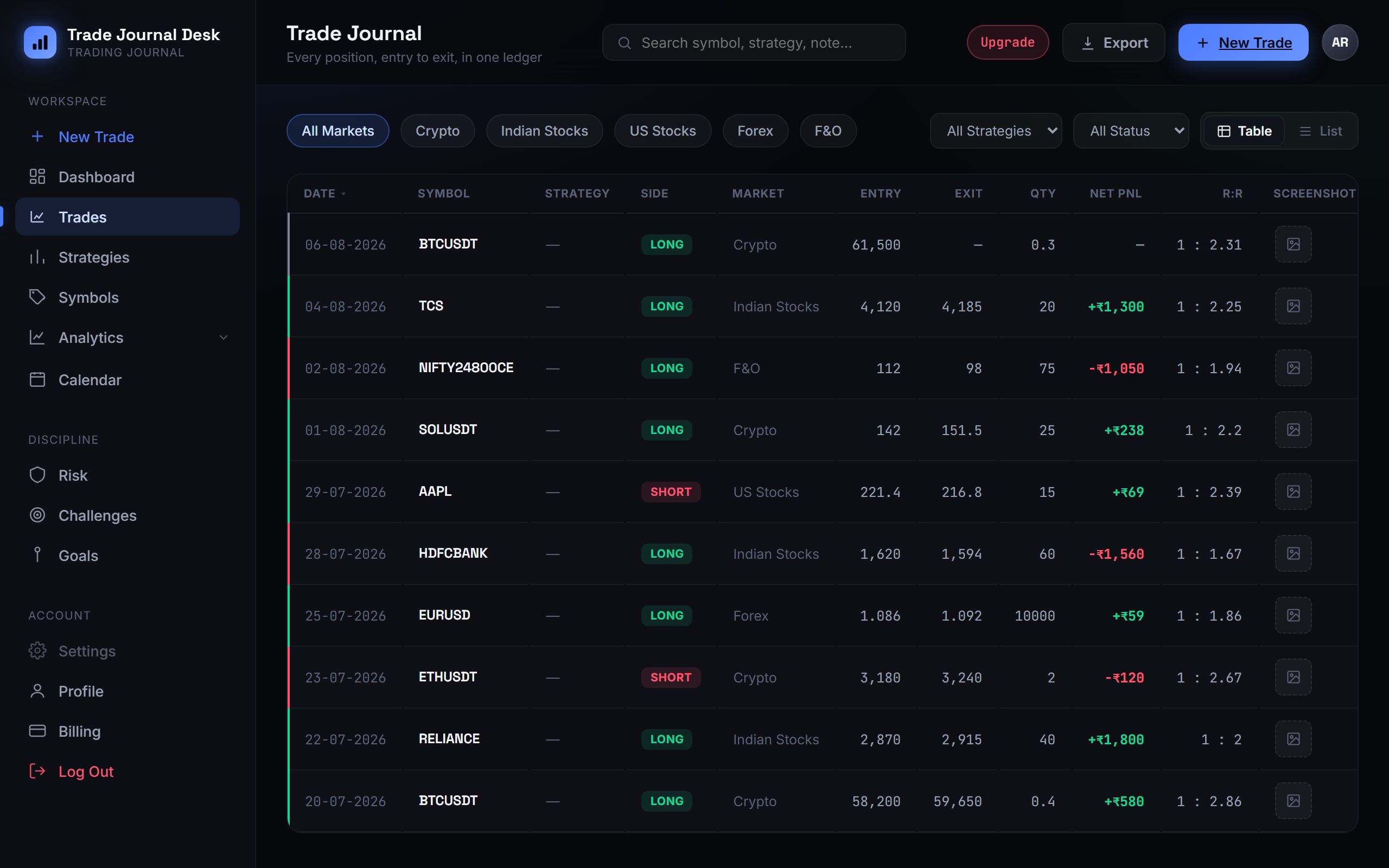
| Trade Recording | Log entry, exit, size, and market for every trade | The foundation — nothing else works without this |
| Performance Dashboard | Win rate, PnL, active trades at a glance | Gives you an honest snapshot instead of a gut feeling |
| Analytics | Profit factor, expectancy, drawdown, day-of-week breakdown | Turns raw trades into decisions you can act on |
| Charts | Equity curve, win/loss distribution, monthly performance | Patterns jump out visually that are easy to miss in a table |
| Calendar | Daily PnL laid out month by month | Exposes overtrading days and streak patterns fast |
| Strategy Tracking | Tag trades to a named setup or playbook | Reveals which strategies actually have an edge |
| Risk Tracking | Risk per trade, daily/weekly/monthly loss limits | Turns "don't overrisk" into a rule you can't quietly ignore |
| Trading Psychology | Tag emotional state before and after a trade | Surfaces FOMO, revenge trading, and fear patterns |
| Emotion Tracking | Win rate and PnL broken down by logged emotion | Makes the psychology data usable, not just recorded |
| Screenshot Upload | Attach chart images to each trade | You'll misremember what the chart actually looked like — the image won't |
| Trade Replay | Revisit a trade's full context during review | Makes the weekly review far more concrete than numbers alone |
| Reports | Exportable summaries of performance over time | Useful for tax records and for tracking long-term progress |
| Cloud Storage | Your data backed up off your device | A crashed laptop shouldn't erase months of trade history |
| Responsive Design | Works properly on a phone, not just desktop | You'll often want to log a trade the moment you close it, wherever you are |
| Dark Theme | Comfortable for long screen-time sessions | Small thing, but you'll notice it during a 2am forex session |
Don't judge a journal by how many features it has — judge it by how few clicks it takes to log a trade. A feature-packed journal you find tedious to update loses to a simple one you actually keep up with, every time.
How to Choose the Best Trading Journal
With the feature list out of the way, here's what to actually weigh when comparing options:
Ease of use
If logging a trade takes more than a minute, you'll skip it on busy days — and busy days are exactly when you need the discipline most.
Analytics depth
Look past the dashboard to what's underneath — win rate by strategy, by day of week, by emotion. Surface-level stats only get you so far.
Speed
A slow, laggy interface is friction you'll feel every single day. Test it before committing, not after.
Chart and screenshot support
You should be able to attach a chart image to a trade in seconds, not through a multi-step upload flow.
Mobile friendliness
Check whether the mobile experience is a real interface or an afterthought squeezed onto a small screen.
Export options
You should always be able to get your own data out as CSV. A platform that locks your history in is a real risk, not a minor inconvenience.
Pricing
Confirm what happens after a free tier — an unclear pricing page is often a sign of an unclear product.
Support
Skim reviews for how the company handles bugs and questions. A small, responsive team often beats a bigger, slower one.
Security
Your trade history is sensitive financial data. Password-protected accounts and encrypted storage should be table stakes, not a premium feature.
Run a two-week trial before deciding. Log every real trade you take during that window in the journal you're evaluating, exactly as you would long-term — same detail, same honesty about losses. Most of the criteria above become obvious within a handful of trades; the ones that feel like friction on day three usually still feel like friction on day three hundred.
Top Benefits of Using a Trading Journal
Put all of that together and the day-to-day difference between journaling and not journaling looks like this:
| Benefit | Without a Journal | With a Journal |
|---|---|---|
| Decision making | Based on gut feeling and recent memory | Based on your own logged evidence |
| Strategy clarity | "I think this setup works" | "This setup has a 61% win rate over 40 trades" |
| Emotional control | Revenge trades and FOMO entries go unnoticed | Emotional patterns are visible and fixable |
| Risk management | Position sizing is a rough guess | Risk per trade is a tracked, enforced number |
| Confidence | Rises and falls with your last trade | Built on a real track record |
| Mistake correction | Same errors repeat for months | Errors get tagged, reviewed, and reduced |
| Performance tracking | A rough mental estimate of "up or down" | An actual equity curve, win rate, and profit factor |
| Tax season | Digging through broker statements after the fact | A dated, exportable record ready to hand off |
None of these benefits show up on day one. They compound — a single trade logged today doesn't tell you much on its own, but 40 of them logged and reviewed consistently will tell you more about your own trading than any course, indicator, or signal group ever could. That compounding effect is really the entire case for journaling in one sentence.
Common Beginner Mistakes
Most of these mistakes aren't unique to trading — they're the same handful of self-sabotaging patterns that show up in any skill where emotion and money are both in play. What makes them dangerous for beginners specifically is that, without a journal, none of them get caught early. They just quietly become habits.
No journal at all. The single biggest mistake — trading purely on memory guarantees the same errors repeat indefinitely.
No review habit. Logging trades without ever reviewing them is just data collection with no payoff. The value is entirely in the review.
Overtrading. Taking far more trades than your strategy actually calls for, usually driven by boredom or the urge to "make something happen."
FOMO entries. Jumping into a move that's already well underway because it looks like it's "about to run" — rarely part of an actual plan.
Revenge trading. Taking a lower-quality trade minutes after a loss to try to win it back immediately.
Ignoring psychology. Treating trading as purely mechanical and skipping the emotional side — where many of the worst losses actually originate.
Ignoring statistics. Trading a strategy for months without ever checking whether it has a real, measurable edge.
Paper Journal vs Excel vs Trading Journal Software
Every beginner starts somewhere. Here's an honest comparison of the three common starting points:
| Capability | Paper Journal | Excel / Sheets | Trade Journal Desk |
|---|---|---|---|
| Automation (PnL, R:R) | None — manual math | Manual formulas | ✓ Automatic |
| Analytics & charts | None | Requires building pivot charts | ✓ Built-in |
| Reports | Manual summarizing | Manual summarizing | ✓ Generated |
| Screenshots | Physically impossible | Clunky, breaks easily | ✓ Native support |
| Mobile access | Always with you, if you carry it | Awkward on a small screen | ✓ Fully responsive |
| Cloud backup | One coffee spill away from gone | If saved to cloud storage | ✓ Always backed up |
| Review workflow | Forces slow, thoughtful writing | No structure enforced | ✓ Structured & fast |
| Learning curve | None | Medium to high | Low |
Paper has one real advantage: the physical act of writing slows you down and forces genuine reflection. It's a fine way to start. Excel is a reasonable middle step. But both hit a ceiling the moment you want real analytics — win rate by strategy, emotion-tagged performance, or a proper equity curve — without spending your evenings maintaining formulas instead of reviewing trades.
How Trade Journal Desk Helps Beginners
This is where it's fair to say plainly: we built Trade Journal Desk around exactly this beginner problem — wanting the benefits of journaling without the overhead of building your own system from scratch. Everything described earlier in this guide — automatic calculations, screenshot support, psychology tagging, risk limits — exists in the product specifically because those are the things beginners told us they either skipped or gave up maintaining by hand within a few weeks.
Every trade you log gets its net PnL, risk, reward, and risk-reward ratio calculated automatically from your entry, exit, quantity, and side — commissions, taxes, funding fees, and slippage included — so there's no spreadsheet formula to maintain. Free accounts get 10 trades to try the full workflow before deciding whether to subscribe.
- Unlimited trade recording (on paid plans) — log every position across every market you trade, with no artificial cap holding back your data.
- Analytics dashboard — win rate, profit factor, equity curve, drawdown, and day-of-week performance, built the moment you close a trade.
- Strategy tracking — tag every trade to a named setup so you can finally see which ones actually have an edge.
- Risk management — configured capital, risk-per-trade percentage, and daily/weekly/monthly loss limits, tracked against your real trades.
- Trading psychology — win rate and PnL broken down by the emotion you tagged before and after each trade.
- Calendar view — every trading day's PnL laid out month by month, so overtrading and streak patterns are impossible to miss.
- Performance reports — exportable summaries for your own records or tax season.
- Trade screenshots — attach chart images before, during, and after a trade, right from the entry form.
- Dark theme & responsive UI — built for long sessions, on desktop or phone.
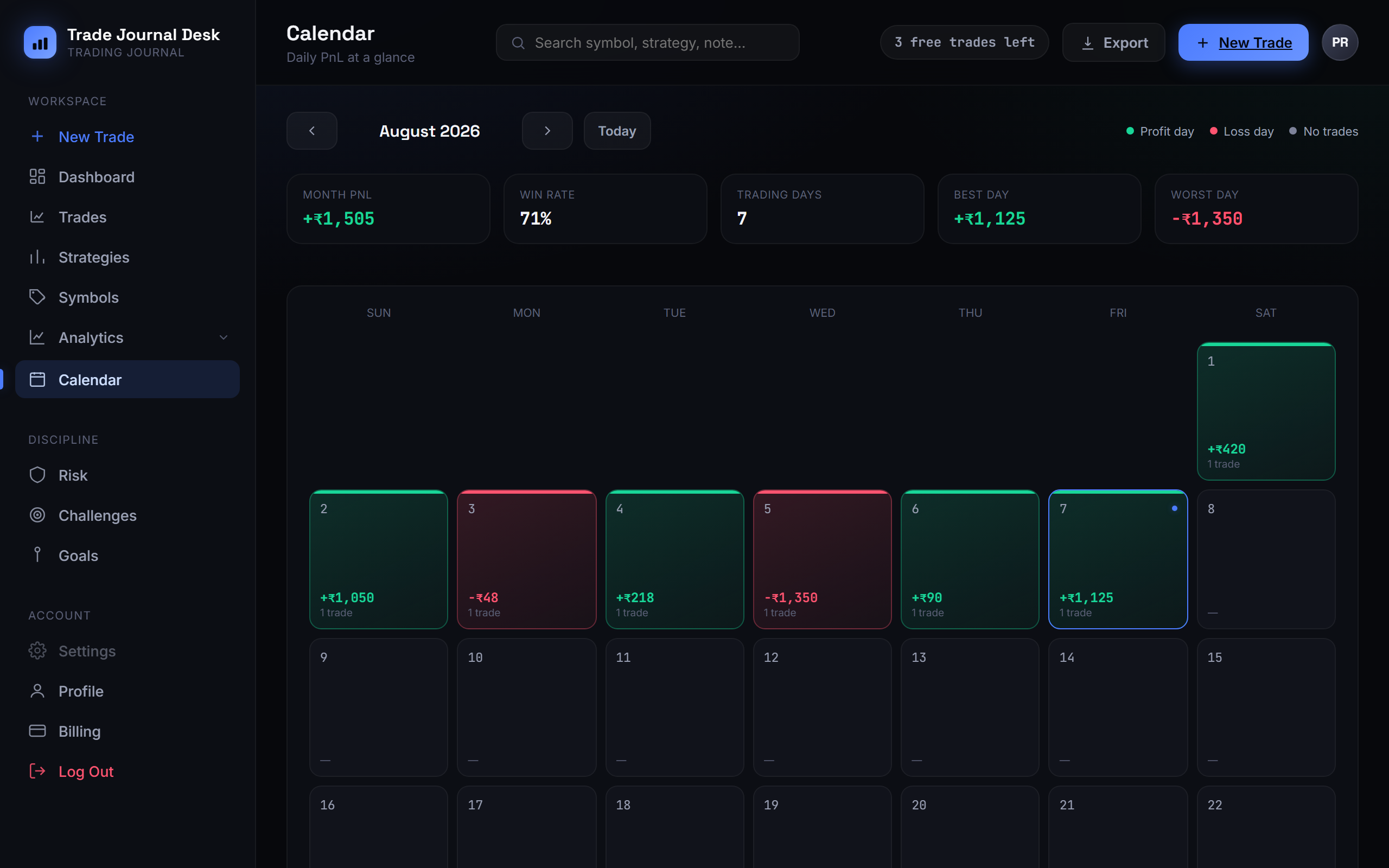
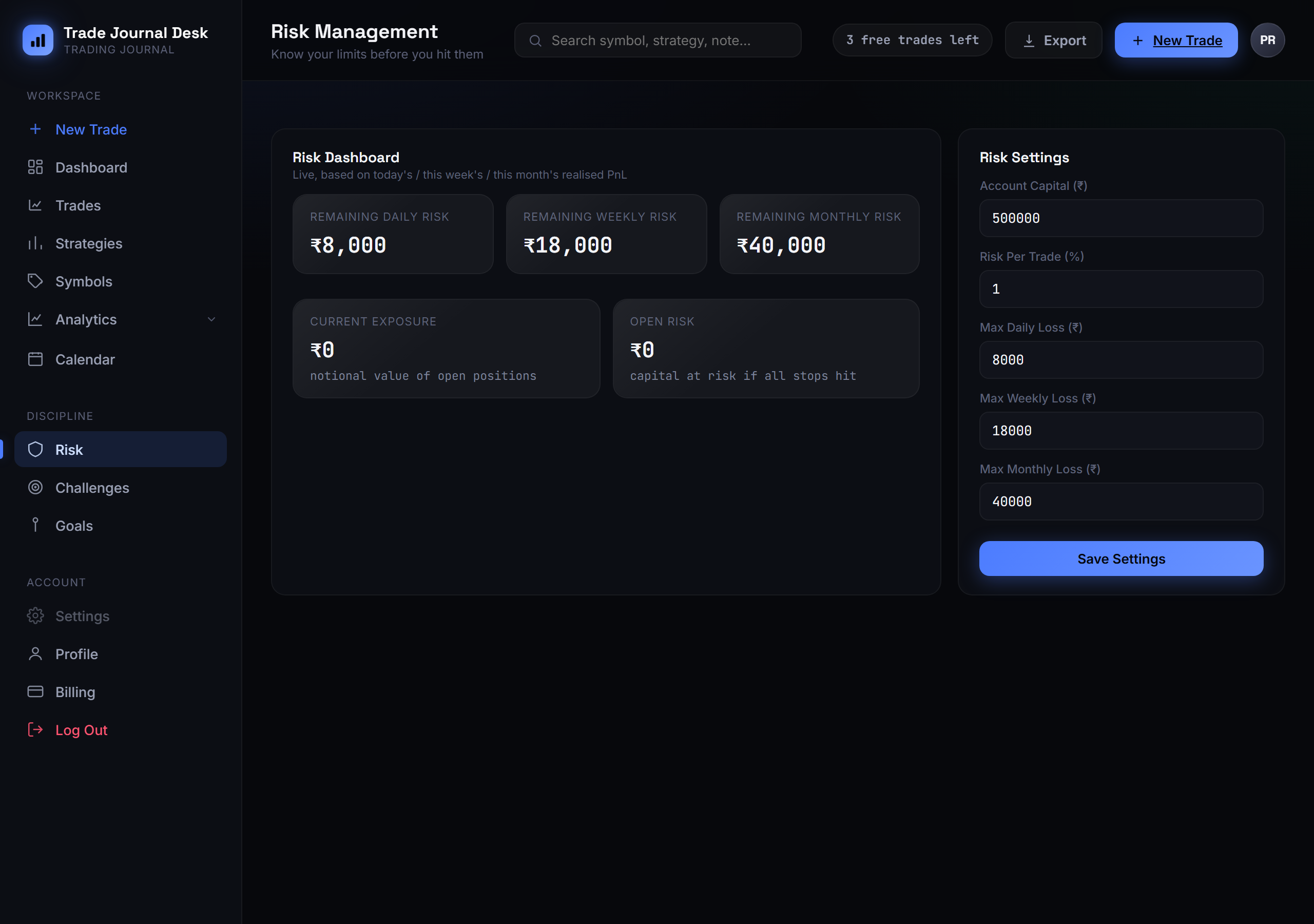
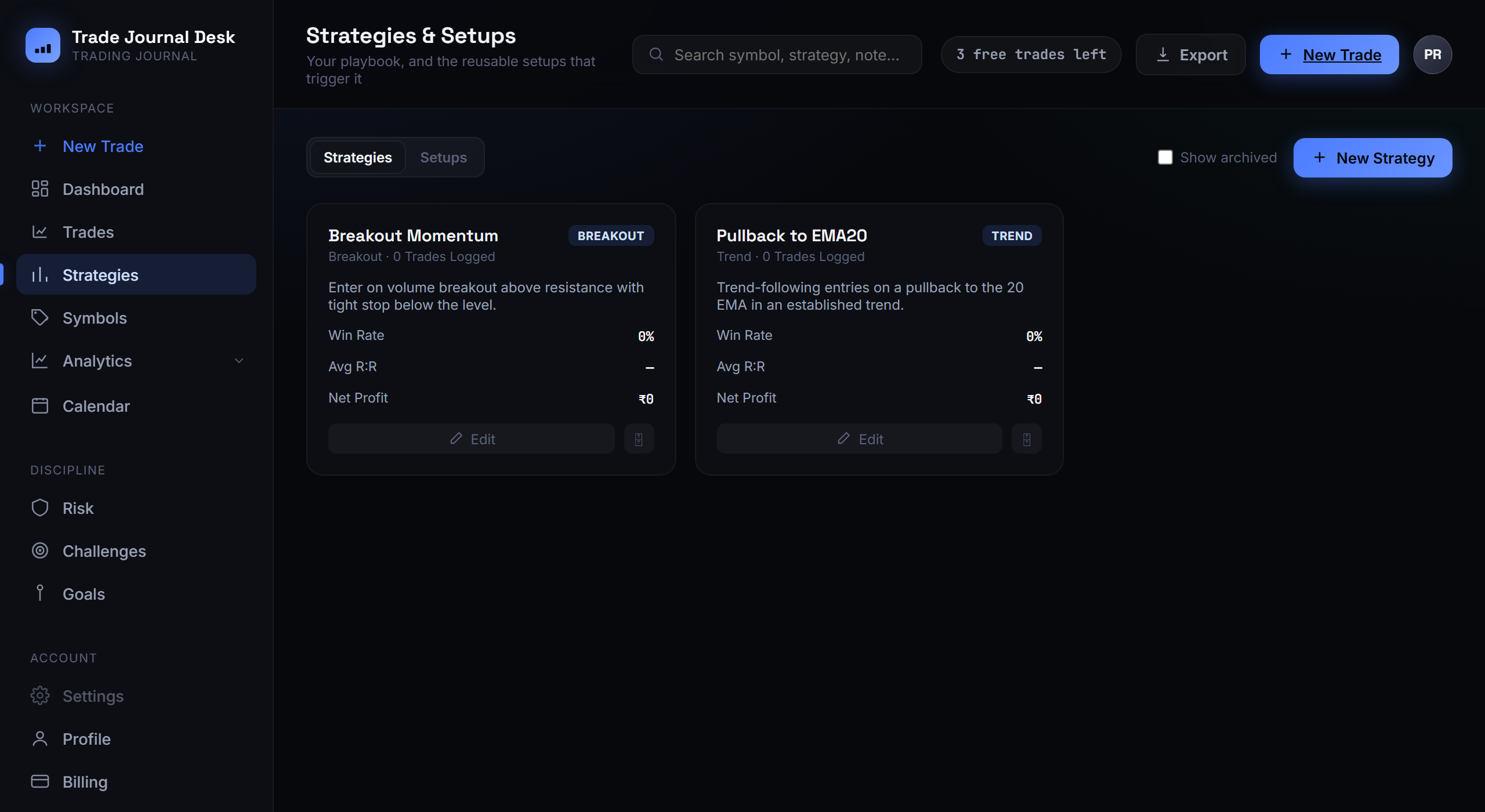
None of it replaces the discipline this guide talks about — that part is still on you. What it removes is the friction between "I should probably log this trade" and actually doing it. You focus on the review; the arithmetic takes care of itself. Every trade tells a story — the point of the software is just making sure you can read it back clearly.
Whichever journal you choose, the habit matters more than the tool. Trade Journal Desk exists to remove friction from that habit — not to replace the discipline of actually reviewing your trades.
Who Should Use Trade Journal Desk?
The core workflow — log, calculate, review — works the same way regardless of what you trade. In practice, it fits:
- Crypto traders — 24/7 markets make consistent logging (and a clear-headed review of overnight sessions) especially valuable. It's easy to lose track of how many 2am entries were actually part of a plan versus driven by watching a chart too long — a journal makes that split obvious.
- Forex traders — multiple sessions and high trade frequency make a fast, low-friction entry form essential. Tagging trades by session (London, New York, Asian) can reveal that your edge is concentrated in one window and close to breakeven everywhere else.
- Indian stock traders — cash and derivatives in one journal, with a symbol library that adapts to NSE/BSE tickers. Useful for keeping a clean, exportable record for both performance review and tax season.
- Commodity traders — the same risk-reward and strategy tracking, applied to a different instrument class, including the wider volatility swings commodities are known for.
- Futures traders — position sizing and risk limits matter even more with leverage in play, and a journal that tracks risk per trade in real terms (not just percentages) keeps that visible.
- Options traders — F&O trades get their own market category without forcing you into an equity-shaped form, so strategy tags like spreads or naked positions still make sense in your review.
Frequently Asked Questions
What is the best trading journal for beginners?
The best trading journal for beginners is one you'll actually keep using — it should log trades automatically, calculate PnL and risk-reward for you, support screenshots, and track your psychology, without a learning curve steep enough to make you give up in week two.
Do I really need a trading journal as a beginner?
Yes — arguably more than experienced traders do. Beginners make the most mistakes and repeat them the most often simply because nothing is being recorded and reviewed. A journal turns those early, expensive lessons into a permanent reference instead of a recurring cost.
Is a free trading journal good enough to start?
For your first trades, yes. A free tier is enough to test whether journaling actually fits your workflow before you commit to a paid plan. Trade Journal Desk, for example, includes 10 free trades with full analytics access.
How is Trade Journal Desk different from a spreadsheet?
A spreadsheet requires you to build and maintain your own formulas for PnL, risk-reward, and win rate, and has no native support for chart screenshots or emotion tagging. Trade Journal Desk calculates all of that automatically the moment you log a trade.
Can I use a trading journal for crypto and forex together?
Yes. A good trading journal treats the market as just another field — crypto, forex, Indian stocks, US stocks, commodities, and futures & options can all live in the same journal, filterable by market at any time.
What features matter most for a beginner's first trading journal?
Automatic PnL and risk-reward calculation, a simple trade entry form, screenshot attachments, and basic win-rate analytics. Advanced features like strategy tracking and psychology analytics matter more once you have 30-50 trades logged.
How much should a trading journal cost?
Many trading journals, including Trade Journal Desk, offer a free tier to try before paying anything. Paid plans typically range from a few hundred to a few thousand rupees a month depending on features — Trade Journal Desk's plans start at ₹49/month.
Is my trading data safe in an online trading journal?
It should be — look for password-protected accounts, encrypted storage, and the ability to export your own data at any time. Never share your broker login or API keys with a journal that doesn't clearly need them.
Can I use a trading journal on my phone?
A good one, yes. Trade Journal Desk's trade entry form and dashboard are fully responsive, so you can log a trade or check your stats from your phone right after closing a position.
How long does it take to see results from journaling?
Most traders notice their first real patterns after 30 to 50 logged trades. Meaningful, strategy-level insight — knowing what actually works for you — usually takes two to three months of consistent logging.
Should I track losing trades too?
Especially losing trades. They carry more diagnostic information than winners do. A journal that only records wins isn't a journal — it's a highlight reel, and it won't help you improve.
What's the difference between a trading journal and a broker's trade history?
A broker's trade history shows what happened financially. A trading journal captures why — your strategy, your reasoning, your emotional state, and the mistake (if any) behind each trade.
Do I need to know how to code or use Excel to use a trading journal?
No. Dedicated trading journal software like Trade Journal Desk is built so you fill in a form and the analytics build themselves — no formulas, pivot tables, or scripting required.
Can a trading journal help me pick better strategies?
Yes — that's one of its biggest advantages. By tagging every trade to a strategy, you can eventually see, in hard numbers, which setups actually make money and which ones just feel exciting to trade.
What is trading psychology tracking and why does it matter?
It's logging how you felt before and after each trade — confident, anxious, FOMO, revenge — so patterns like overtrading after a loss become visible in your data instead of staying a vague feeling.
Is Trade Journal Desk suitable for options and futures traders?
Yes. Futures & options is its own market category, and the same core fields — entry, exit, stop loss, target, quantity, and risk-reward — apply whether you're trading an index option or a straightforward equity position.
How many trades should I log before trusting my statistics?
Treat anything under 20-30 trades as too small a sample to draw firm conclusions from. Real confidence in a win rate or strategy edge usually needs 50 or more logged trades.
Can I export my data if I stop using the journal?
You should always be able to — a journal that locks your own trade history in is a red flag. Confirm export options (CSV at minimum) before committing to any platform long-term.
What's the biggest mistake beginners make with journaling?
Starting strong and quietly stopping after a losing week — usually because reviewing losses feels uncomfortable. That's exactly when the journal is most valuable, not least.
Does a trading journal guarantee profits?
No, and be skeptical of anything that claims it does. A journal doesn't make your strategy profitable — it shows you, honestly, whether it already is, and exactly what to fix if it isn't.
How often should a beginner review their journal?
A brief daily check, a proper weekly review of every trade with screenshots, and a monthly look at your overall metrics — win rate, profit factor, and your most expensive recurring mistake.
Is Trade Journal Desk free to try?
Yes — you can log up to 10 trades for free with full access to analytics, so you can test the workflow before subscribing to a paid plan.
Final Verdict
There's no single "best" trading journal that fits every trader — but there is a best trading journal for you, and it's whichever one you'll still be filling in honestly three months from now. Paper works if you'll actually write in it. A spreadsheet works until you outgrow it. Dedicated software works if it stays out of your way instead of adding friction to a habit that's hard enough to build already.
What matters far more than which tool you pick is what you do with it: log every trade, not just the flattering ones; review on a real schedule, not just when things go well; and treat consistency as the actual goal instead of chasing a quick win. A good trading journal isn't a shortcut to profits — it's an investment in becoming the kind of trader who improves steadily, trade by trade, instead of guessing forever.
If you're comparing options right now, don't let that comparison become another form of procrastination. The traders who improve fastest aren't the ones who found the perfect journal — they're the ones who started logging trades on day one, with whatever tool was in front of them, and stayed honest about it through the losing weeks. Pick something today, commit to it for a month, and let your own data — not another review, not this one included — tell you whether it's working.
Keep Exploring
Ready to stop guessing and start improving?
Start using Trade Journal Desk today and discover why Every Trade Tells a Story.